
Given the heightened awareness of risk in the supply chain, academics and career advisors are telling young professionals to take on more education as they climb the corporate ladder.
“We are now placing a greater emphasis on critical thinking in our curriculum,” said Dr. Theodore P. Stank, Bruce Chair of Excellence in Business, University of Tennessee. “That includes learning the ‘soft’ skills of management and leadership.
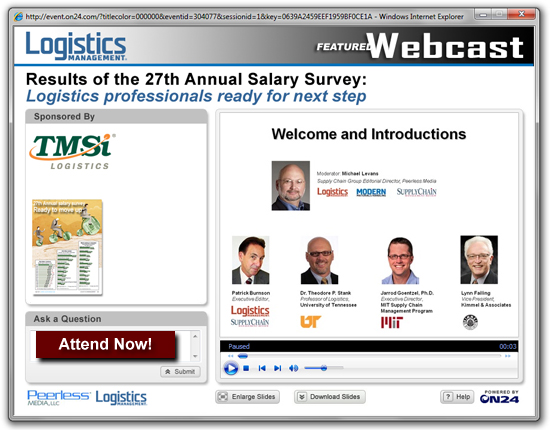
Stank was one of three industry experts involved in this week’s webcast, “Logistics Management 27th Annual Salary Survey: Ready to Move Up.” The on-demand event is archived on our sister publication’s site, and is now available to registered readers.
Joining Stank, was Jarrod Goentzel, Ph.D., and executive director of the MIT Supply Chain Management Program, and Lynn Failing, vice president of Kimmel & Associates, Inc., a national executive search firm specializing in the logistics and supply chain industries.
“To fully cope with risk in the supply chain, people need to have a more diversified education,” said Goentzel. “That means being able to speak the language of finance as well as supply chain management.”
Failing agreed, adding that professionals should also take advantage of any opportunity to learn on the job.
“If you are managing a supply chain, then learn something about procurement,” he said. “And if you are in procurement, learn something about transportation. It’s all part of an integrated operation that helps the bottom line.”
Stank also shared an observation that championed education as an ongoing pursuit.
“Machinery and technology can become obsolete in a short time, but the same is true of people in the workforce. Unless you continue to grow and take on new responsibilities a person becomes stale and vulnerable,” he said.
In a wide-ranging and animated dialogue the three experts also shared their advice with management: Don’t take your people for granted.
“Our job candidates are interviewing companies just as hard as the companies interview them,” said Goentzel. “And the best will demand that they are given a solid career path that includes opportunity to advance.”
Failing agreed, noting that companies have a chance to “mentor” the most promising new hires so that they will remain with the company.
“Young people want more from a job than just a good salary,” he said. “They demand a different lifestyle balance, and insist that the corporate culture is one that they can be proud of.”
For related articles click here.
SC
MR

Latest Supply Chain News
- Innovators Netstock, Pickle Robot win NextGen Solution Provider awards
- Bigger trucks versus broken bridges and roads
- From salon to dock door: Repurposing scheduling software for inbound flow
- The biggest barrier to AI in supply chains isn’t technology
- Rebuilding a planning function around the physical world
- More News
Latest Podcast
 Explore
Topics
Latest Supply Chain News
- Innovators Netstock, Pickle Robot win NextGen Solution Provider awards
- Bigger trucks versus broken bridges and roads
- From salon to dock door: Repurposing scheduling software for inbound flow
- The biggest barrier to AI in supply chains isn’t technology
- Rebuilding a planning function around the physical world
- Why companies blame the wrong supplier … and miss the real failure
- More latest news
Latest Resources
About the Author
Patrick Burnson, Executive Editor

Patrick is a widely-published writer and editor specializing in international trade, global logistics, and supply chain management. He is based in San Francisco, where he provides a Pacific Rim perspective on industry trends and forecasts. He may be reached at his downtown office: [email protected].
Follow SCMR on social media.
@SupplyChainManagementReview on Facebook
@SCMR on Twitter
SCMR on Linkedin
Subscribe

Supply Chain Management Review delivers the best industry content.

Editors’ Picks



